
Hood County Court Records After a Jail Arrest
Hood County court records after a jail arrest sit downstream from the Hood County Jail booking process. A person may first appear in the sheriff's bond/inmate listing with a booking date, offense wording, warrant field, and bond amount. That jail profile is useful for current custody, but it is not the filed criminal case. After arrest and booking, the person is magistrated, investigators submit reports, and a prosecutor decides whether to file, reject, reduce, amend, or present the matter to a grand jury.
Felony prosecution is handled through the Hood County 355th District Attorney, whose office represents the State of Texas and victims in felony criminal cases arising in Hood County. Local police departments and the Hood County Sheriff's Office conduct the initial investigation and turn evidence over for prosecution review. Once accepted, a case may end by guilty plea, trial, dismissal, appeal, or another court disposition. Use jail inmate records for current custody and booking detail, and use jail mugshots for booking-photo context. Use court records to confirm filed charges, case status, hearings, disposition, and sentence.
The official Hood County court record search starts at the Hood County Tyler public-access portal.
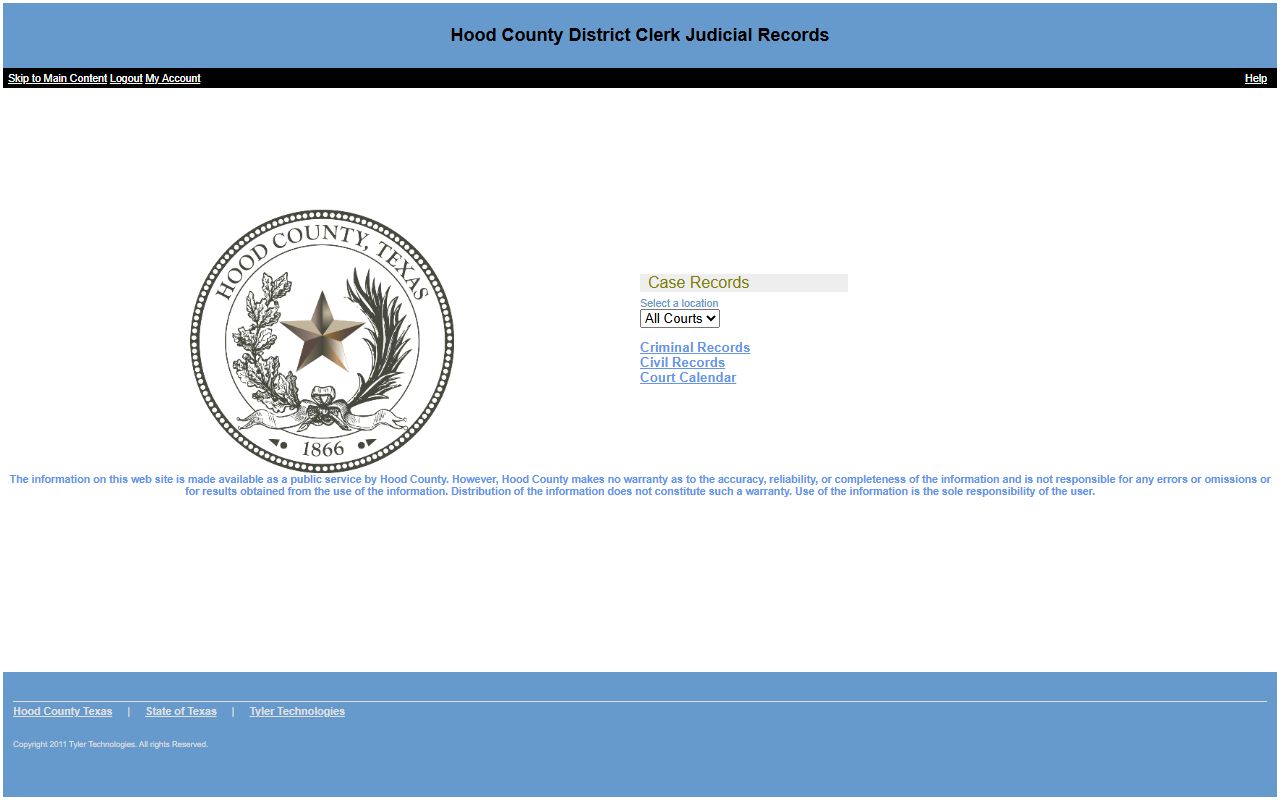
The portal is the online court-record path, while the sheriff bond roster remains the current-jail path for arrest and booking data.
How to Find Hood County Court Records After an Arrest
The online case-search route is the Hood County Tyler public-access portal. Portal screens can vary by Tyler configuration, so avoid assuming every field appears in the same place. The reliable starting points are a defendant name, case number, filing date range, and case type when available. If the jail profile gives only an offense description and no cause number, search by name first, then compare filing dates, charge text, and court level before treating the result as the correct case.
- Open the Hood County Tyler public-access portal.
- Search by defendant name, or use a case number when the clerk, attorney, bond paperwork, or court notice provides one.
- Open the matching case and read the filed charge list, court, filing date, events, and disposition fields shown by the portal.
- Compare each filed charge with the jail booking offense, because booking charges can differ from the prosecutor's filed charge.
For clerk help, the County Clerk is Christine Leftwich at 1200 W Pearl Street, Granbury, TX, 817-579-3222, Monday through Friday from 8:00 AM to 5:00 PM. Felony prosecution questions generally route to the 355th District Attorney at 1200 W. Pearl Street, Granbury, TX 76048, 817-579-3245. Sheriff reports, incident reports, calls for service, and booking records are separate from court filings and should use the sheriff public-information route when the record is not online.
| Search Item | How It Helps | Limits |
|---|---|---|
| Name search | Best first step when the jail profile has no case number. | Common names require careful date and charge comparison. |
| Case number | Most precise route when known from court paperwork. | A jail booking number is not necessarily a court case number. |
| Filing date or date range | Helps connect an arrest to a later court filing. | Filing may occur after booking or after prosecutor review. |
| Case type | Separates criminal cases from civil, family, probate, or other matters. | Exact portal labels can vary by screen. |
How Court Charges Get Filed After an Arrest: Complaint, Information, and Indictment
Booking at Hood County Jail records what the arresting agency reports at intake. The court record begins when a charging document is filed or when a case is otherwise placed before the court. In Texas, misdemeanors may proceed by complaint or information. Felonies are commonly presented to a grand jury and proceed by indictment unless a waiver or other lawful charging instrument applies. The Hood County District Attorney presents felony evidence to county grand juries and continues handling felony cases on appeal when needed.
| Complaint | Information | Indictment | |
|---|---|---|---|
| Filed By | Law-enforcement or prosecuting authority, depending on case type. | Prosecutor. | Grand jury after presentation of felony evidence. |
| Common For | Lower-level or initiating misdemeanor matters. | Misdemeanors and some cases allowed by law. | Felony matters unless waived or otherwise lawfully charged. |
| Record Role | States the accusation used to begin proceedings. | Sets out the prosecutor's formal accusation. | Shows a grand jury's charging decision. |
The charge phrase in the Hood County bond profile can be an arrest-side label. The final court-record wording can be narrower, broader, reduced, amended, or dismissed after review. That difference is common enough that a custody lookup should not be treated as a conviction lookup.
Charge Status in Court Records After an Arrest
Charge status is the court-record snapshot of where the filed accusation stands. A pending charge may still be awaiting hearing, plea, grand-jury action, trial, or dismissal. A filed charge can be amended to correct wording, reduced as part of a plea or prosecutor decision, or dismissed when the State does not proceed. The Hood County jail profile may still show the original arrest offense even when the court file later changes.
| Status | What It Means |
|---|---|
| Pending | The filed accusation remains open and has not reached final disposition. |
| Amended / Reduced | The prosecutor or court record reflects changed charge wording, level, or count structure. |
| Dismissed | The case or count was ended without a conviction on that charge. |
| Nolle Prosequi | A prosecutor decision not to proceed on a charge or count, when used by the court record. |
Felony charging information is also explained by the Hood County 355th District Attorney.
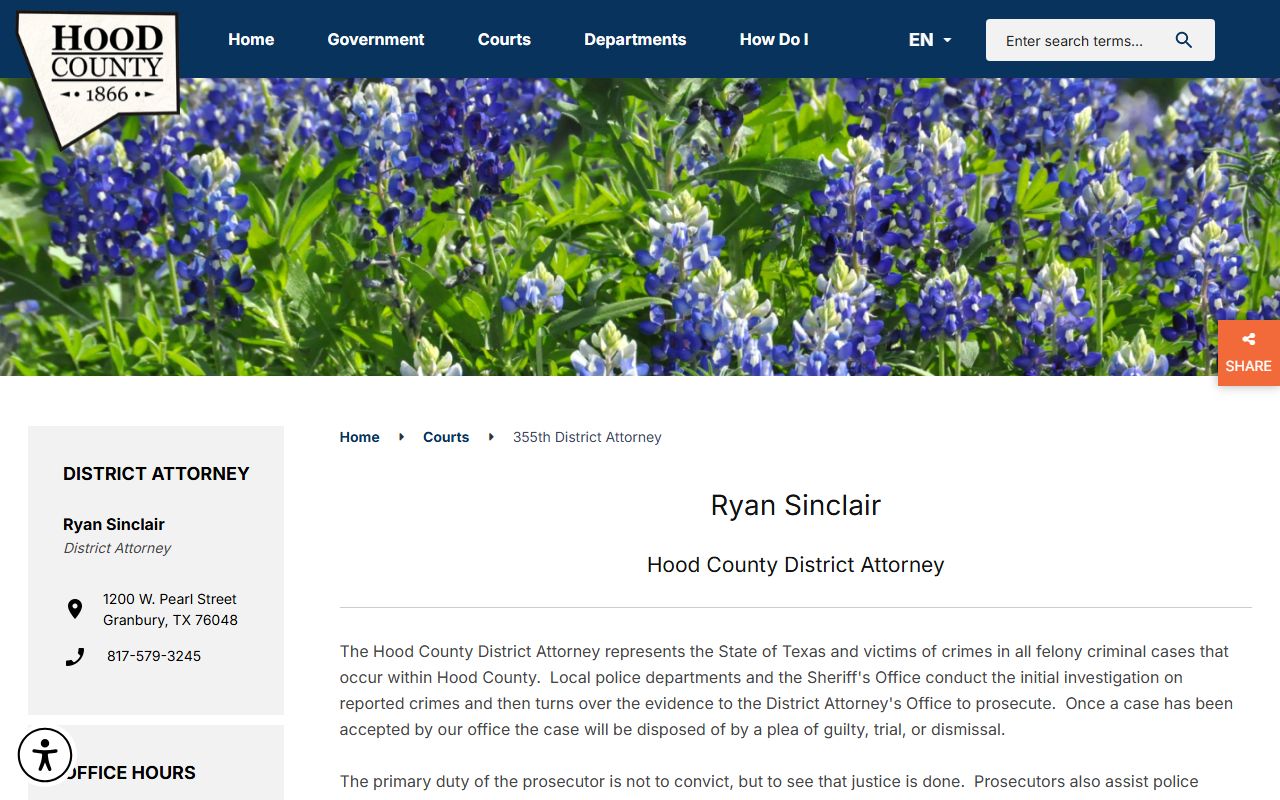
That office is the local source for felony prosecution role, victim services, grand-jury presentation, and appeal responsibilities.
Bond and Release After an Arrest
Bond is tied to magistration and court authority, even though the practical amount may appear on the Hood County bond profile. The sheriff's Bail Bonds and Fines page says bonds can be posted 24 hours a day, fines can be paid 24 hours a day, and bonds must be posted by a Hood County bondsman. It also says Hood County fines require an exact cashier's check or money order payable to Hood County, while Granbury City fines require exact cash. Texas Code of Criminal Procedure Chapter 17 governs bail generally, but the sheriff page supplies the local posting instructions.
| Bond Type | How It Works |
|---|---|
| Cash Bond | Full amount deposited where accepted by the court or jail process; Hood County's page does not list this as the main local posting route. |
| Surety Bond | Commercial bond through a bondsman; Hood County says bonds must be posted by a Hood County bondsman. |
| PR / Own Recognizance | Release based on a promise to appear, if ordered by the magistrate or court. |
| No-Bond Hold | Custody continues because no bond is set or another warrant, detainer, parole, court, ICE, or agency hold blocks release. |
Always separate bond from the court-record outcome. Bond describes release conditions before final disposition. It does not prove guilt and does not mean the filed charges will stay the same.
Warrants That Lead to an Arrest
A warrant can lead to a Hood County Jail booking and then to court records after arrest. The inspected research found that a Hood County website path labeled for online warrants returned a 404, so a working sheriff warrant-search page should not be assumed. Use the jail bond portal to see whether a warrant has already resulted in current custody, use the court portal for filed cases and failures to appear, and use Granbury Municipal Court for city-level or Class C matters when the issue is municipal.
Common warrant categories include arrest warrants, bench warrants, search warrants, fugitive or out-of-county warrants, and parole or blue warrants. The Hood County bond profile has a Warrant column in the offenses table, but that field is only part of the custody profile. A person with a possible active warrant should verify instructions with the court, an attorney, or the issuing agency rather than relying on an unofficial lookup.
Charges vs. Convictions
An arrest and a filed charge are accusations, not convictions. Court records after a Hood County arrest may show a pending charge, a dismissed charge, a guilty plea, a trial verdict, or a sentence. The distinction matters for employment, housing, licensing, reputation, and family decisions because a jail profile can show an arrest while the court record later shows dismissal or a different final result.
| Charge | Conviction | |
|---|---|---|
| Stage | Accusation | Verdict or plea |
| Burden of Proof | Probable cause | Beyond reasonable doubt |
| Public Record | Often public unless restricted, sealed, juvenile, or otherwise confidential. | Often public unless sealed, restricted, or subject to a specific confidentiality rule. |
Sealed vs. Expunged Arrest Records
Texas Code of Criminal Procedure Chapter 55 governs expunction of qualifying criminal records. Expunction and sealing are not the same thing, and neither happens merely because someone asks a website to remove a listing. A person seeking to limit official Hood County arrest or court records after dismissal, acquittal, or another eligible disposition generally needs the proper court order and must route that order to the agencies that hold the records.
| Sealed | Expunged | |
|---|---|---|
| Visibility | Hidden from public | Destroyed / treated as never existed |
| Law Enforcement | Limited access | Very limited |
| Eligibility | Depends on Texas law, case result, waiting periods, and court order. | Depends on Chapter 55 eligibility and a court order sent to record holders. |
Background Check Considerations
Casual public-record lookups are different from regulated background checks. Texas Government Code Chapter 411 governs criminal-history information and dissemination rules, while private consumer background screening is subject to federal and state compliance duties. A person using Hood County court records after an arrest for a legal, employment, licensing, rental, credit, or insurance decision should use lawful, authorized channels and verify records with the originating clerk, sheriff, court, or state agency.
Important: Public lookup information is not a consumer report and must not be used for FCRA-covered decisions.
Restricted Court Records After an Arrest in Hood County
Texas public access is broad, but not unlimited. Texas Government Code Chapter 552 presumes public information is available unless an exception applies. Court filings are generally requested through clerks, while sheriff reports, booking photos, incident reports, and calls for service use the public-information route. Juvenile records can have separate confidentiality rules under Family Code Chapter 58. Active investigations, expunction orders, privacy or safety exceptions, sealed records, and some criminal-history limits can affect what a clerk, sheriff, or portal releases.
For sheriff law-enforcement records not available online, Hood County routes public-information requests to PIALaw@hoodcounty.texas.gov, by phone routing at 817-579-3316, or by mail or in person at Hood County Law Enforcement Center, PIA Request, 400 Deputy Larry Miller Dr, Granbury, TX 76048. Written requests should ask for existing records and include enough date, name, case, arrest, or incident detail for staff to identify the record. Court filings should generally be requested from the appropriate clerk rather than through a sheriff PIA request.
Magistration Between Arrest Records and Court Records
Hood County publishes a public magistration livestream page through the sheriff's jail section. The page states that public access is available when magistrations are in session, but times vary, no specific hour is promised, and the stream may pause for breaks or delays. That timing matters because family members may see a person on the jail roster before a bond decision, court filing, or complete charge review is visible elsewhere.
The Hood County jail arraignments page is the source for the public livestream timing notice.
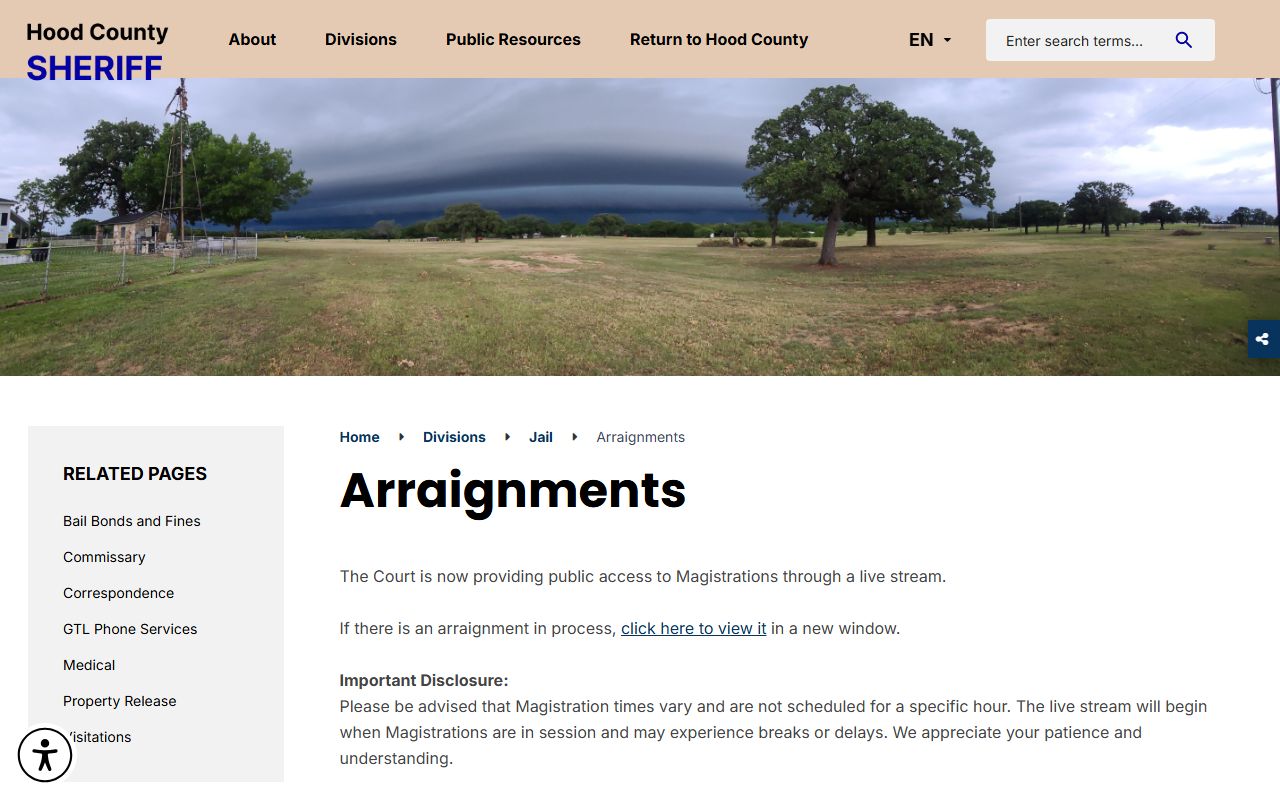
The livestream notice helps explain why arrest, bond, and court records can update on different schedules instead of appearing as one complete record at once.